Key Findings
School choice has been one of the central organizing principles of K-12 education policy and school reform for more than three decades. While the larger debate about the advantages and disadvantages of school choice rages on, it is clear that school choice policies are here to stay. Open enrollment public schools, magnet schools, charter schools, virtual schools, homeschooling, and private schools are increasingly widespread. Spurred by recent and rapid growth of school vouchers and “education savings accounts” (ESAs), two new forms of choice have also emerged: microschools and subsidized private schools. Homeschoolers can also draw on ESA funds to reduce costs, making this option more feasible and attractive. As a result, we calculate that at least one-third of students nationally no longer attend their neighborhood public schools. The new federal Education Freedom Tax Credit, which takes effect January 1, 2027, will further extend school choice.
The National Center for Research on Education Access and Choice (REACH) has been working for almost a decade to better understand not only how well these different forms of school choice work but also how the specific elements of these policies contribute to improved outcomes and equitable access. Below, and in this downloadable policy brief, we summarize what we have learned from our own research. A key theme is that, when it comes to school choice policy and implementation, the details matter. The evidence below shows how. You can click on any of the nine key policy areas listed and learn more about REACH's research. For a more technical and complete review of all of the best research, including 90 non-REACH studies, you can also view this systematic review.
Table of Contents
1. Transportation
2. Enrollment Systems and Student Eligibility
3. Information
4. Governing Agencies
5. Provider Eligibility
6. Input/process-based Regulation
7. Outcomes-based Accountability
8. Funding
9. Coordination and Capacity-building
Conclusions about the 9 Key Policy Elements
Detailed Discussion of Evidence and REACH Studies
The arguments for school choice are rooted in the economic theory that free markets lead to the most efficient outcomes, and sometimes equitable outcomes, too. Decades of research, however, have demonstrated the limitations of this thinking. Schooling markets do not behave the way markets are supposed to. For example, many parents are poorly informed, distance limits practical schooling options, and schools have incentives to exclude certain students. All of this may stunt the competitive process and stifle outcomes, especially for marginalized groups. This implies that markets might not improve efficiency or equity as described above, unless the government intervenes.
We identified nine government policy elements that could address these market failures in school choice settings. Below, we summarize key findings about each of them. These are organized into three groups. Choice policies 1-3 focus on the demand side, or what we call “choice facilitation” for families (transportation, enrollment systems/eligibility, and information). The remaining choice policies focus on the supply side, or what schooling options are available to families. Policies 4-7 focus on “school governance” (governing agencies, provider eligibility, input/process-based regulation, and outcomes-based accountability) and choice policies 8-9 focus on “school resources” (funding and school capacity-building/coordination). To be clear, not all of these policy areas have demonstrated impact on access or outcomes. Some, such as regulation and capacity/coordination, deserve attention precisely because there is so little evidence and we need to learn more.
Choice Policy 1: Transportation
Families are generally choosing among brick-and-mortar schools that require students to get to and from school almost every day. This limits families’ feasible choices and shapes their preferred options. A government policy requiring transportation therefore has the potential to expand families’ choices, improve the match between their preferences and school services, and create more competition across schools. Required transportation may take multiple forms, including public mass transit or more customized “yellow bus” service. Some schools might voluntarily provide this service to increase enrollment, but schools serving advantaged students have less incentive to do so, making them less accessible to marginalized groups.
Much of our REACH research on transportation was conducted using “natural experiments,” making it possible to study its causal effects. A series of studies in New York City by Sarah Cordes, Amy Ellen Schwartz, and colleagues reinforces the importance of distance and transportation, not only for whether families choose schools but also for how they experience them.
The first question is, does transportation increase access to schools? Do students enroll in schools more often when those schools, or school systems, offer transit? The answer is yes. This is highlighted in Figure 1 below, which shows that bus availability affects access to charter schools and other types of schools. Some of this analysis pertains to traditional public, or “zoned” schools, which means this point does not only apply to school choice policies. That said, the effects do not seem large. For example, the largest effect in the figure suggests that families are three percentage points more likely to choose a charter school when transportation is offered.
Figure 1: Students Are More Likely to Enroll in Charter and Zoned Schools When Those Schools Offer Transportation
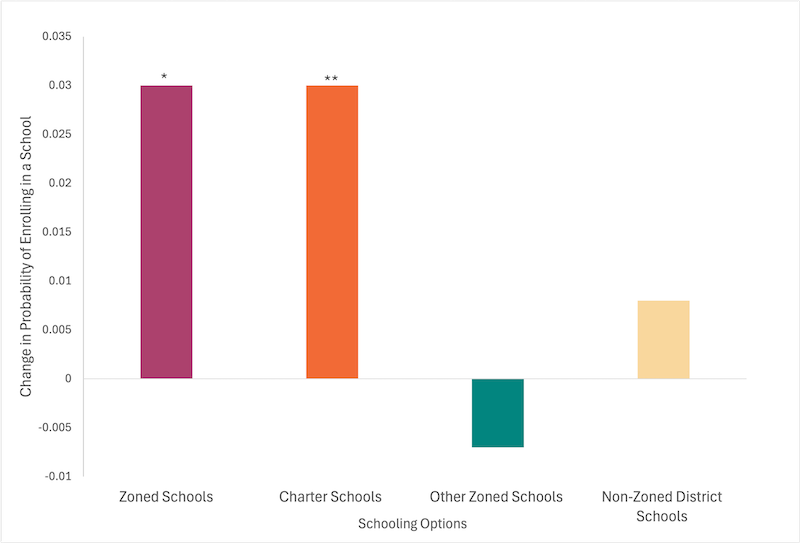
Note: The estimates in this figure are from regression analyses that include student fixed effects. * indicates statistical significance at p<0.10. ** indicates significance at p<0.05.
Does transportation access also change how students experience the schools they ultimately enroll in? The answer is, yes. Figure 2, from one of the New York City analyses, shows that bus availability reduces attendance issues for students living farther away. Again, the effects are not large–the largest effects show an attendance increase of 1.5 percentage points, which is equivalent to about three additional days of school per year.
Figure 2: Bus Transportation Reduces Absenteeism
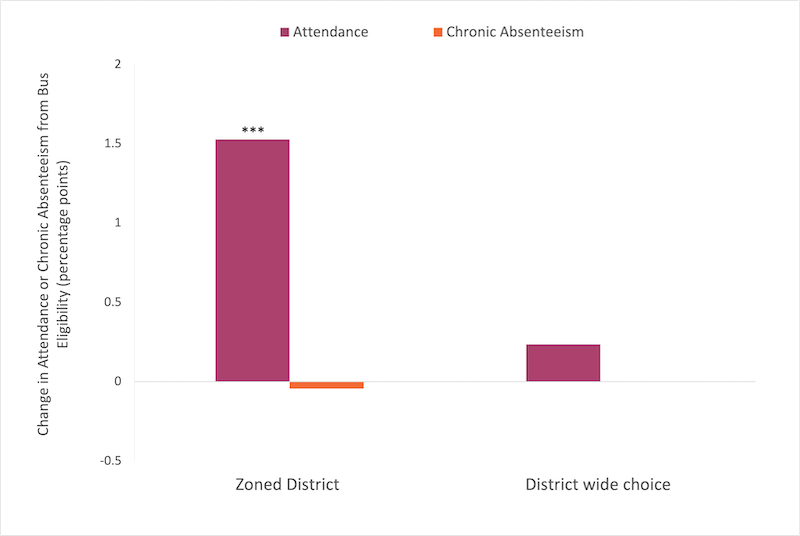
Note: Estimates examine students who are near the cutoff for free transportation, which is 1 mile for 5-6th grade students and 1.5 miles for 7-8th grade students. The estimates in this figure are from regression analyses. * indicates statistical significance at p<0.10. ** indicates significance at p<0.05. *** indicates significance at p<0.01.
While some might question whether transportation studies in New York City are broadly applicable, we note that school transportation should matter less in a city like New York, given its dense population and extensive mass transit. The fact that transit matters at all in New York means that it probably matters at least as much elsewhere. This is reinforced by our other studies on the topic.
Two additional studies in Michigan corroborate the New York City results. One REACH study, by Danielle Sanderson Edwards, estimates that yellow bus transportation in Michigan increased attendance among economically disadvantaged students by 0.63 percentage points and reduced chronic absenteeism by 20 to 25%. Another study of Detroit, by Jeremy Singer and Sarah Winchell Lenhoff, found that bus transportation is especially important in high-crime areas. A REACH study in Baltimore also suggests the potential of public mass transit in improving school choices.
The above results suggest that we might also see effects of transportation on students’ academic achievement. After all, parents do choose schools partially based on academic outcomes and attendance increases achievement. Again, the results are as predicted. Student achievement declines as distance from school increases, but Figure 3 shows this negative influence is substantially offset by bus transportation.
Figure 3: Bus Transportation Reduces the Negative Effect of Distance on Student Outcomes
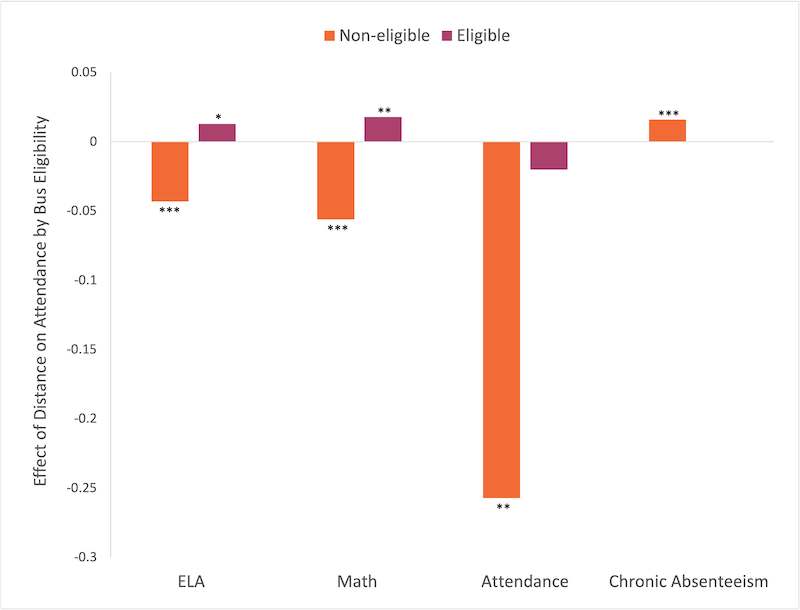
Note: These results show the effect of living one mile further from the nearest high-performing school on student outcomes among grades 3–8 students in public housing who are near the cut-off for transportation assistance. For students eligible for pupil transportation, the effect of distance is the sum of the non-eligible and eligible estimates. ELA and math test scores are measured in standard deviation units. Attendance captures the percentage of days a student is present. Chronic absenteeism indicates the probability a student is absent more than 10% of the time. (* p < 0.10, ** p < 0.05, *** p < 0.01)
Summary of Findings
Our REACH results, as well as our systematic review, reveal that families are more likely to choose schools near their homes, even after controlling for school quality and other characteristics. Providing access to transportation also reduces this constraint, gives families more options, and has some, albeit small, effects on student outcomes. This is especially true for disadvantaged families who are less likely to have personal automobiles or who have jobs with rigid schedules that make school pickup/dropoff more difficult.
Policy Implications
A key goal of choice is to increase access to schools, especially for marginalized students who otherwise have fewer options, and research clearly shows that organized transportation can accomplish that. However, reliable transportation can be quite costly and therefore could take away from instructional resources that are more directly related to student learning. These costs need to be weighed against the positive, albeit modest, effects reported above. Economists like to say that there are “no free lunches,” but there are also “no free rides” when it comes to transportation.
Choice Policy 2: Enrollment Systems and Student Eligibility
A key problem with school choice is that demand for specific schools is often very high, so some process is needed to decide who gets in. Most school choice enrollment systems are decentralized, meaning that every school has its own process and every child must submit applications separately to every preferred school. This limits the need for coordination and schools often prefer controlling enrollment this way, but decentralized enrollment creates several problems:
a. There is no way for families to clearly signal which school they want most.
b. It creates high costs for schools, as each school has to manage enrollment separately, and for families, who have to manage a wide range of deadlines and application processes.
c. Some students might get admitted to no school at all or might hold multiple seats until the last minute.
d. Schools have so much control that they might select students on illegal or inappropriate criteria.
All these problems run counter to the objective of giving families a choice. They are also most likely to harm marginalized students whose families lack the resources to navigate complex systems and who are more likely to have their applications rejected, especially by the most in-demand schools. These issues can be addressed through centralized or unified enrollment systems that all schools and families participate in. Usually organized by school districts or other government agencies, these systems allow families to express their preferences by submitting a single rank-ordered list of schools for each child. Having a single process also reduces costs for schools and families and ensures that every student is admitted to one school (not more). Finally, this side-steps selection on inappropriate/illegal criteria such as excluding students with disabilities or only selecting high-performing students.
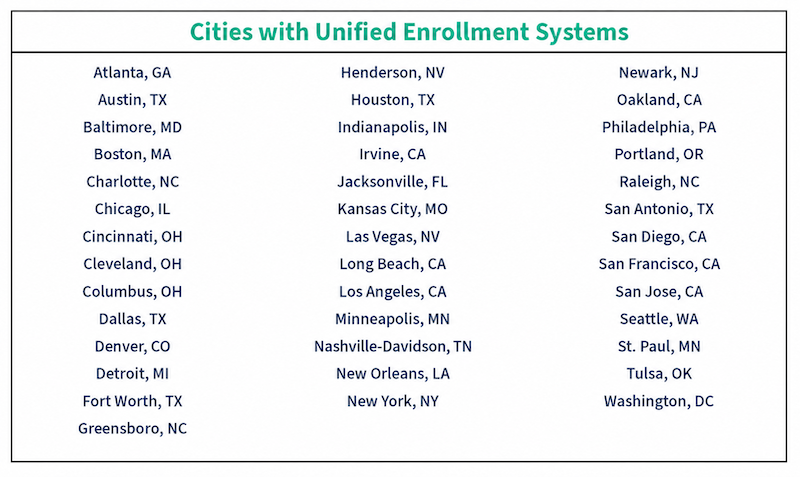
Many REACH studies on enrollment systems have focused on what happens when decentralized choice is replaced by centralized choice. One study, led by Jon Valant, Jane Lincove, and Nicolas Zerbino, begins by simply documenting the cities that use centralized enrollment (Figure 4). Almost all of these cities are among the very largest in the country, which is where centralized enrollment simplifies and facilitates choice the most.
Figure 4: List of Cities Using Centralized/Unified Enrollment Systems as of 2024-25
The authors also examined how school demographics changed following the implementation of centralized enrollment in most of these locations. Centralized enrollment increased the enrollment of non-white students in historically white schools, principally because the total enrollment levels of these schools increased, not because white students shifted to other schools.
Two additional REACH studies have involved deep dives into New Orleans’ experience with choice-based enrollment systems. In one study, echoing the above national study, Jane Lincove and Jon Valant studied what happened when individual schools entered centralized enrollment. They found that centralized enrollment increased access to high-demand, disproportionately White schools for Black students. Taking this together with the prior findings, centralized enrollment appears to increase access for marginalized students overall.
An additional study, by Jon Valant and Brigham Walker, started by asking, why is it that Black and lower-income students in the city attend lower-performing schools and what role does the enrollment process play? They first converted school letter grades into GPA-like points (e.g., A=4.0), then compared the average school performance rating across racial groups. The authors found that the gap in school performance emerged in the application stage and widened in later steps in the choice process. Figure 5 documents this pattern, starting on the left with how families ranked schools.
To understand why, it is important to recognize that parents’ rankings reflect a combination of parent preferences and barriers to access. Marginalized families are likely to rank high-quality schools lower because of factors that make it difficult for them to access those schools. As in most cities, Black students in New Orleans, for example, live further away from high-quality schools, which shapes the rankings they submit in the centralized enrollment system (see the Transportation section of this page regarding the role of distance).
Figure 5: Racial Gaps in School Quality Are Already Wide at the Application Stage and Widen a Year After Initial Enrollment
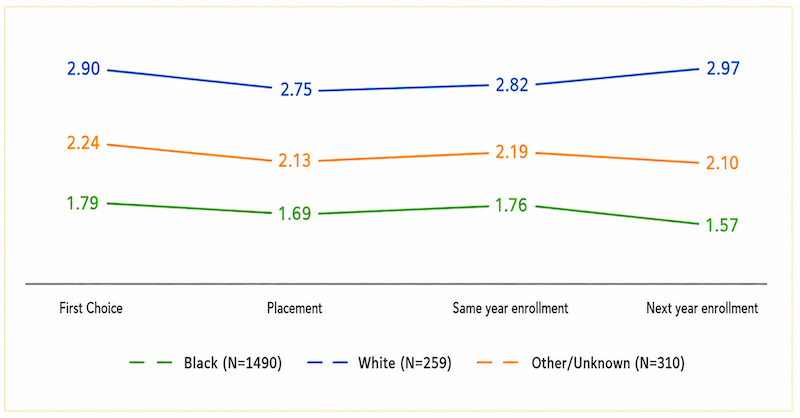
Note: The average school performance measure converts the state-assigned school letter grade to a grade scale (A=4, B=3, C=2, D=1, F/T=0). First choice indicates students’ first choice on the application. Placement indicates the rating of the schools students were placed in. Same year enrollment and next year enrollment indicate the letter grade of the schools where students enrolled in the same and following school years, respectively.
Figure 5 also shows that the racial gap in school performance is fairly stable throughout the choice process. However, a year after initial enrollment, Black students end up in lower-quality schools than they are initially placed in–again, perhaps because higher-quality schools are too far away.
Student eligibility is also a key part of enrollment systems. If students are not eligible, then they cannot enroll. Jane Lincove studied selective-admission high schools in Baltimore that admit students based on middle school performance. Such high schools are common in urban areas, often called magnet schools, and typically enroll disproportionate shares of white and high-income students. She finds that this is driven by the low performance of disadvantaged students, not that these students aren’t applying. This raises concerns about why large achievement gaps persist and also informs how enrollment systems work. Lincove also raises the possibility that allowing school counselors to submit applications to selective schools might increase the likelihood that marginalized students apply to them.
“Priority categories” are another element of enrollment systems. These differ from eligibility criteria and, as the name implies, increase the odds that certain students are admitted. These priorities, too, might lead to more unequal access in the later stages. While many enrollment systems rely partly on lotteries, priority within the lottery is sometimes given to students who live closer to schools, to schools their siblings attend, and to students who have recently experienced a school closure. Valant and Walker found that in New Orleans Black applicants were less likely to have geographic priority and less likely to have sibling priority. While not explicitly tied to race, these preferences had indirect implications that made it more difficult for Black students to attend the high-quality schools they preferred.
Valant and Walker also examined what would happen if those priority categories were changed. They found that changing the priorities in the centralized placement algorithms or adding seats to oversubscribed schools can alter placement patterns, but their overall impact on racial and income integration is limited because of factors and forces beyond the enrollment system. Again, most of the gaps are driven by other barriers to accessing particular schools, such as distance, which limit the potential benefits of centralized enrollment in increasing access. Also, while Valant and Walker study centralized enrollment, these conclusions about priority categories apply to all types of enrollment systems.
While much of the work in the brief uses quantitative methods and examines clearly measurable factors, an additional research agenda, led by Julie Marsh, used qualitative methods–interviewing key education stakeholders. Qualitative analysis can help interpret quantitative analysis, provide greater depth of understanding, and surface issues that researchers might not otherwise consider. This work included interviews about enrollment systems.
Huriya Jabbar led a REACH study that interviewed parents about their experiences with different enrollment systems in Denver, Detroit, New Orleans, as well as some suburban districts. Parent perspectives help us to interpret patterns like those above and to better understand how the theoretical advantages and disadvantages of different enrollment systems play out in practice.
In decentralized enrollment systems, such as those in Detroit and suburban/rural areas, interviews showed that decentralized processes are fragmented and burdensome. Families juggled separate applications, mismatched timelines, and “exam school” tests alongside varying charter and open-enrollment deadlines. Without centralization, each school set its own deadline and some parents gained admission to multiple schools, while others gained none at all, as predicted.
This study also found evidence that some schools used the application process to screen out families (sometimes called “cream-skimming”). As one parent put it, “When you turn in an application, you have to physically bring it in… You can’t mail it, you can’t fax it, you can’t email it over. You have to physically walk in and take the time out of your day to bring that in, bring in your shot records, bring in your birth certificate, bring in your proofs of income” (p. 32). These steps likely deterred more marginalized families with less access to transportation and to jobs with less flexible hours from visiting schools.
Centralized enrollment, such as that in New Orleans, also reduced the compliance costs associated with the application, but did not reduce stress. This is because of another key feature of the New Orleans choice landscape: families have no default option. The authors call this “forced choice” for that reason. Forced choice especially affects families of kindergartners and those who first move to the city. They cannot simply move to a neighborhood and know what schools their children can attend. Centralized enrollment also involves a long wait that ends long after deciding where to live. That long wait to know where your child will attend school was frustrating to some parents. One interviewed parent in Denver reported that, after submitting the centralized enrollment form, there was “no information process, no information from the district, no information from the schools you applied to. No information nowhere until two weeks prior to school. You don’t know if your kids are going to go to your local school.” Late notices aren’t necessarily a part of centralized enrollment systems, but the centralized enrollment process does take time to play out and those running the processes evidently communicate too little, too late.
In contrast, in Detroit, decentralization made enrollment more complicated but, in some ways, less stressful because each child had guaranteed access to a traditional public school, too. They didn’t have to participate in the choice process at all if they didn’t want to.
Recall that centralized enrollment might also affect schools themselves. When deciding whether to participate in centralized enrollment systems, high-demand schools sometimes worry that centralized enrollment will attract lower-performing students and make it harder for schools to meet accountability standards. However, Lincove and Valant found no evidence that centralized enrollment reduced school performance metrics. That is, centralized enrollment increased equity without side effects that worried some critics.
Summary of Findings
Enrollment systems of all types are often burdensome for families–choice takes a lot of work–and create particular stress when parents receive information late and when there is no default school option. Those burdens and restrictions fall mainly on marginalized groups, leading them to participate less actively in school choice programs. Priority categories and academic requirements tend to reduce access for marginalized students and schools sometimes use enrollment systems to select students in ways that are not allowed, i.e., “cream-skimming.”
But not all enrollment systems are created equally. Centralized enrollment systems are less burdensome than decentralized ones, and increase access for marginalized groups, but their complexity and opaqueness lead some families to see centralized, algorithm-based systems as illegitimate and unfair.
Policy Implications
The results for enrollment systems highlight a key theme of the associated policy brief and REACH’s work generally–the details matter. The way families experience enrollment depends on how those systems are designed and implemented and how they interface with information and other choice-related policies. Key details include the presence of a default school option and relatively quick enrollment systems that allow parents to plan. Also, many cities use both decentralized and centralized choice, creating further confusion and stress.
Centralized enrollment clearly has many advantages over decentralized enrollment, though it is critical that policymakers take pains to explain how it works and help families fill out the forms. It’s also important to remember that for many families, fairness is judged by the enrollment outcome, not the procedure. No enrollment system, no matter how well designed and implemented, can generate support and trust among parents who believe there are few good schooling options to choose from.
One way to address some of these concerns is by offering “choice zones,” as in Denver and San Francisco and other cities, where zones are smaller than the whole district. However, while the number of choices is limited with this method, it improves predictability by narrowing the set of potential schooling options to a smaller number of schools that are all relatively close to home.
Choice Policy 3: Information
All markets require that consumers have good information to choose wisely among options, but gathering information about schooling is inherently difficult. Many key elements and outcomes are difficult to measure. Also, for information to be useful, it has to be comparable across schools and it’s difficult for schools to coordinate data collection and reporting. In some choice settings, this problem is addressed by providing information through centralized parent guides, enrollment centers, personalized assistance, school fairs, or directly within centralized enrollment systems.
Online, third-party user-review platforms also increasingly provide parents with an array of information. The REACH team examined the GreatSchools platform to learn about reviewers and how they differ across school types. As Figure 6 shows, the reviews focus mostly on overall quality–usually involving adjectives rather than references to specific strengths. School staff and school culture are the next most common topics.
Figure 6: Overall School Quality and School Staff Are the Most Commonly Mentioned Topics in the GreatSchools User Review Platform
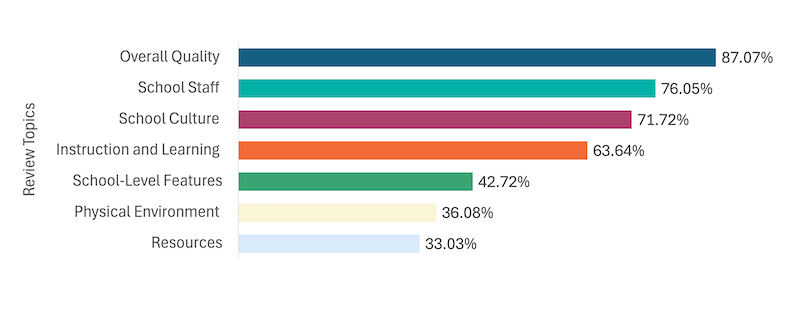
Note: Figure 6 shows the percentage of reviews mentioning each topic according to the AI-NLP analysis (2009-2019). Reviews that mention more than one topic are counted multiple times.
The study of GreatSchools also examined how review content varies across school types. As Figure 7 shows, charter and private school reviews focus more on instruction and learning and school features like religion. They also focus less on school staff than traditional public school reviews. These differences might reflect that families in traditional public, charter, and private schools prioritize–and therefore write about–different factors.
Figure 7: Charter School Reviews on the GreatSchools Site Focus More on Instruction and School-level Features, While Charter and Private School Reviews Mention School Staff Less, Compared with Traditional Public Schools
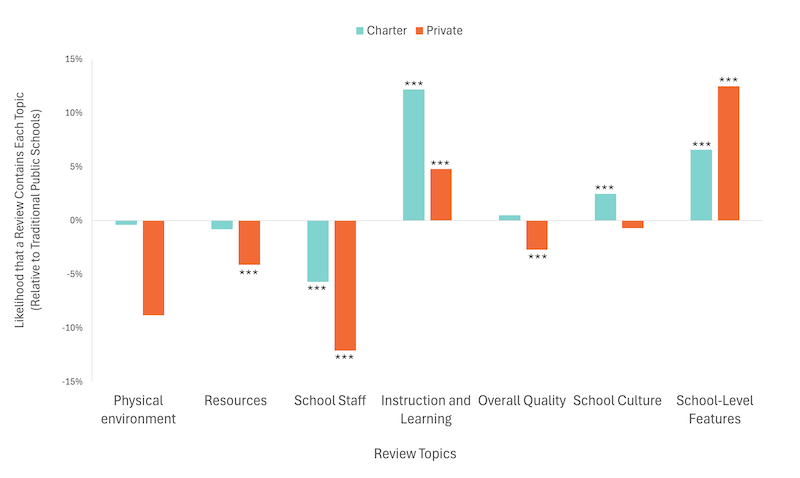
Note: Figure 7 shows the difference in the percentage of reviews mentioning each topic for charter and private schools compared to traditional public schools according to the AI-NLP analysis (2009-2019).
The usefulness of information sources like GreatSchools for family decision-making is unclear. The site offers both standard information about student outcomes and demographics. It also has millions of user reviews, offers schools a chance to respond to them, and uses artificial intelligence to summarize across reviews–information that would otherwise be haphazard and difficult for users to digest. The organization also reports that half of parents nationally view the site each year.
However, the content cannot be verified and only a tiny percentage of parents and students leave reviews. User review platforms are also “passive” and “static” in the sense that families have to find them on their own and cannot ask questions to help apply the information to their situations. Enrollment centers and counseling are also passive in this sense, but allow families to ask questions and get answers from knowledgeable people.
More active and dynamic information sources are possible. One organization, EdNavigator, specializes in doing just that. In New Orleans, the district contracted with EdNavigator to provide choice support to families whose schools were being forced to close to help them find a good alternative. These families were also given a priority in the centralized enrollment system, making it easier for them to gain access to high-quality, in-demand schools.
Jon Valant led a REACH study on EdNavigator’s work in New Orleans. His results, shown in Figure 8, indicate that families in closed/takeover schools who received EdNavigator support and enrollment priority in New Orleans were much more likely to end up in highly rated schools than other parents who switched out of low-rated schools that were not closed or taken over. While we cannot, strictly speaking, separate the effects of EdNavigator support from the enrollment priority associated with closure, the study did indicate that this higher enrollment rate is partly driven by higher application rates to high-performing schools. This suggests that the effect was likely not only about the choice priority and EdNavigator made a difference, too.
Figure 8: Families That Received EdNavigator Support and Priority Were Placed in Higher-Rated Schools
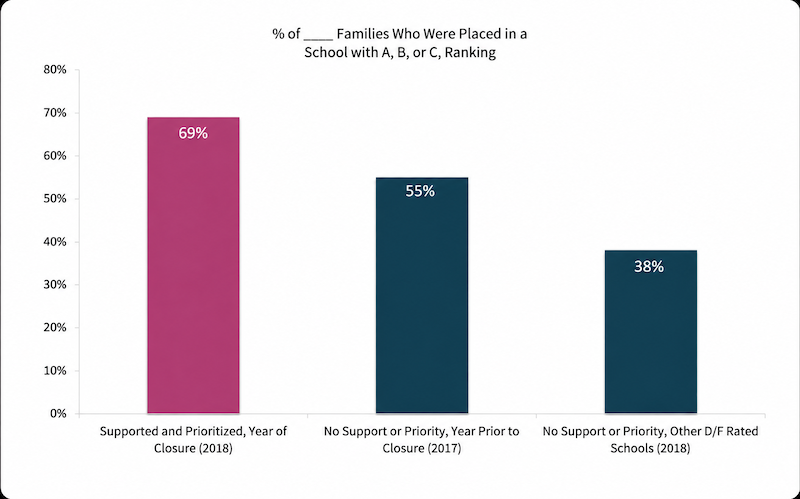
Note: “Supported” means students were helped by EdNavigator. “Prioritized” means students had a priority to get their preferred school in the centralized enrollment system.
As with other elements of choice policy in this brief, we again approached the information topic through interviews. In a REACH study led by Huriya Jabbar, the authors found that ⅔ of the interviewed parents conducted extensive research, including school tours, even in places where centralized information was available. This was partly because the information in the booklets was complex and often included over 100 school options. One New Orleans parent commented that she “had to take a district-led class to understand the school performance and rating system” (p. 25). The authors of the report commented that, “Across sites, parents voiced frustration about the lack of information on websites during the choice process” (p. 23).
Still, parents’ frustration with the available information “was greater in the cities [like Detroit] and suburbs that did not provide pooled information on school options” (p. 23). Enrollment guides, such as those available in New Orleans and Denver, not only provided information about schools but helped families quickly identify the plausible options to give them a place to start their more extensive information gathering.
Parents were particularly likely to comment on information issues in Detroit, which had no centralized information source. One charter parent wanted to know “what their curriculum was like. I would’ve liked to know they [the school] didn’t have books” (p. 24). Another found it “was shocking to find out the school had no special classes like Spanish or Art—information not available online” (p. 24). And a suburban Michigan parent said much of the online information was “outdated” (p. 24).
As a result of these problems, some parents commented on the need for parents to actually visit schools in person. One New Orleans parent said: “Visit the schools, because from what I saw on the internet, the school’s website, the pictures, is not what I seen when I toured the school. So, you have to be hands-on. You have to actually go there, visit, you know, talk to the principal” (pp. 24–25).
In other cases, parents thought the available information was vague or too focused on test scores. “What was hard for me was the information that they give you is vague,” commented one Denver parent. “[T]hey tell you how they rated as far as [the district] rates them... But what those things don’t tell you is, are the staff and admin going to be open to you coming in and volunteering whenever you feel like it, are they going to require things of me that I’m not willing to do? Those sorts of things are hard to figure out” (p. 25).
Summary of Findings
Information is important in all types of decisions, including the schools that families choose. Some schooling information comes from coordinated or centralized sources, but the most important source is family social networks. Research shows that providing information beyond these usual sources consistently alters families’ school choices, suggesting that the usual sources leave families imperfectly informed and that additional, coordinated information sources would improve choices and outcomes. As with transportation and enrollment systems, marginalized groups are at a disadvantage when it comes to information.
Policy Implications
Providing clear and easily accessible information about schools is critical to reducing the burden on parents and is generally inexpensive, especially compared with transportation. Word of mouth and informal sources can be helpful, but limited, haphazard, and unequally available. GreatSchools addresses this need on a national basis, but again based on reviews by a select group. More intensive information from school advisors like EdNavigator is more costly and rare but could both reduce frustration and improve student outcomes.
Local parent guides can help fill these gaps. In New Orleans, for a time, a local non-profit leader led the collection of detailed information. Like GreatSchools, this included student outcome information but went further to include extensive information about afterschool, extracurricular, and arts programs. Many school districts have websites that serve this function, though they only cover district-governed schools.
Another challenge is that information can steer parents toward particular schools and away from others. This means that whoever is creating such sources can have a real, yet subtle, impact on the education market, separate from schools and parents themselves. What information is placed at the top or in a larger font can sway parents’ decisions. Some may view these “nudges” as paternalistic and prefer taking steps through other policies, such as transportation and enrollment systems, that expand options without pushing parents toward particular schools.
Choice Policy 4: Governing Agencies
All government policies require some agency to set objectives, monitor success, and enforce rules. A key question in school governance is whether a governmental agency is responsible for actively monitoring the success of individual schools and/or has the authority to open and close them. In the charter school world, this type of active governing agency is called an “authorizer.”
With private school choice, however, there is no authorizer and schools decide almost completely on their own whether to open or close. Where they do exist, authorizers are often the same as those governing traditional public schools: school districts. However, charter authorizers also include state agencies, independent charter boards, universities, and non-profits.
One key policy question is whether to have a charter authorizer independent of local school districts. Naturally, school districts are less inclined to open charter schools that would compete with the traditional public schools they already govern and manage. In one REACH study, we found just that–the introduction of an independent, statewide charter authorizer significantly increased the share of students enrolled in charter schools (Figure 9).
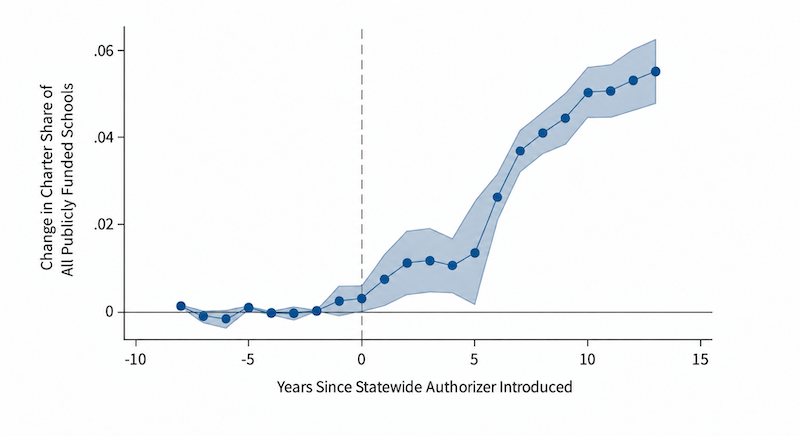
Note: The figure plots the differences in charter share between states that added a statewide charter authorizer and states that did not. More specifically, these results use the Callaway and Sant’Anna difference-in-differences method.
Increasing the number of charter schools with an independent charter authorizer does not, however, mean that such authorizers improve quality. The same study found that, controlling for school funding levels, the presence of an independent charter authorizer was weakly associated with lower average charter school quality, though this result was not quite statistically significant and might not reflect a causal effect.
Another way to understand governing agencies is to examine their objectives. One REACH study, by Katrina Bulkley, Julie Marsh, and Laura Mulfinger, involved interviewing state leaders in five states about their school choice landscape. While these interviews focused mainly on the design of choice policies rather than the governing agencies themselves, their comments highlight the varying objectives and suggest ways in which such governing perspectives might shape choice implementation.
According to the authors, those interviewed “tended to foreground… that choice was a vehicle for innovation, for allowing markets to operate schools more efficiently, and for ensuring parents’ freedom to make decisions regarding their children’s education” (p. 2). That might not sound surprising until we consider what was absent. Those interviewed almost never focused on equity or ensuring that marginalized students were well served. Limited effort was put toward providing meaningful information about school options, viable transportation, or enrollment processes that enable access. The degree to which interviewees focused on these assorted objectives–innovation, efficiency, freedom, and equity–varied across interviews and likely also across the governing agencies in which they work.
In another REACH study, led again by Katrina Bulkley, our team focused specifically on charter authorizers’ priorities and actions. (Those interviewed in the study above were “state education leaders” but not authorizers.) The authors examined nine authorizers, including state agencies, universities, and school districts, across five states, as well as a sample of applications to those authorizers from organizations seeking to open charter schools. They then summarized the charter applications received by each authorizer.
Figure 10 below highlights the results. Higher scores (larger bars) indicate a stronger focus on equity for that authorizer. (Names of the authorizers at left in the figure are pseudonyms.)
The first observation from this figure is that the equity focus varied substantially across authorizers; contrast the low score of Lake CC with the high score of Midwest University. The results also vary considerably across authorizers within states (compare the bars across rows within each of the two grey boxes). Finally, the authors saw no pattern by authorizer type–some of the university authorizers seem to prioritize equity about the same as school districts.
While not evident from this complex figure, the authors also note that these equity scores are positively correlated with the signals that those authorizers sent to the public about their aims, e.g., on their websites and in published mission statements. If the authorizers signaled that they cared about equity, then the school applications focused more on equity. This reinforces that it’s not just state law that affects how choice plays out but governing agencies, too.
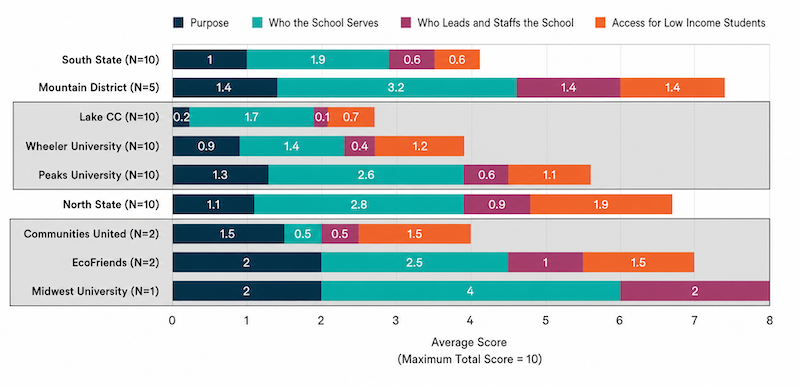
Note: This figure shows the results for 9 authorizers in 5 states. The top shaded box contains authorizers from the Lake State. The bottom shaded box contains authorizers from the Midwest State. The number of applications analyzed for each authorizer appears next to the authorizer’s name (N).
Summary of Findings
The presence, number, and type of active governing agencies affect the number of choice schools available and likely affect the quality and types of schools as well. School districts authorize fewer choice schools because doing so creates competition with their other schools. Additional governing agencies are also likely to increase the number of schools that open, since each agency will have different objectives. Other evidence in our review focuses on how private schools are less likely to participate in voucher programs if doing so means greater government regulation.
Policy Implications
The decision to have an active governing agency is key. This is what most distinguishes charter schools and open-enrollment public schools from recent voucher/ESA programs. But there is also variation within choice policies: some state charter policies allow district authorizers only, while others allow one or more additional types. As we have pointed out throughout this brief, there are likely trade-offs involved. Without the standards that active governing agencies might impose on school entrants, increasing the number of schools likely means allowing lower-quality schools in, too.
A related question is, how large do we want the traditional public school sector to be? In the discussion of enrollment systems, we pointed out that parents experienced much more stress when they did not provide default options and traditional public schools are the main way to provide that. Without active governing agencies, more choice schools will open, likely drawing more students from traditional public schools.
Choice Policy 5: Provider Eligibility
Almost all choice programs are subject to some form of school eligibility criteria. Even tuition-based private schools usually have to be accredited (Arizona and Florida are exceptions). Charter schools, as discussed above, also have to apply and be selected by a charter authorizer. Advocates for free market approaches argue that such requirements are counterproductive because they exclude schools that might better serve students. By this logic, bad schools will be forced out by market competition–students just won’t attend them–so there is no need for eligibility restrictions. But there are many reasons to believe the market will be imperfect and that additional restrictions are necessary to keep out bad actors, just as consumer protection regulations protect the food supply from dangerous chemicals.
One REACH study showed that virtual schools are particularly ineffective in Oregon. This topic has proven especially difficult to study because students self-select into these programs and, unlike charter and private school programs, no lottery-based experiments have been conducted. This is the most convincing virtual school study to date because the authors controlled for an extremely detailed set of family background measures, including income and parental education. They also examined long-term student outcomes, including educational attainment, employment, and earnings. The results, shown in Figure 11, indicate that students in virtual schools did worse than similar students in traditional public schools. Other evidence, along with the global experience with COVID, also reinforces the idea that virtual education is worse on average. This suggests there is a case to restrict eligibility to brick-and-mortar schools, though we cannot rule out that virtual schools are helpful for the particular students who choose to attend them.
Figure 11: Students Attending Virtual Schools Have Worse Long-Term Outcomes on a Wide Variety of Metrics
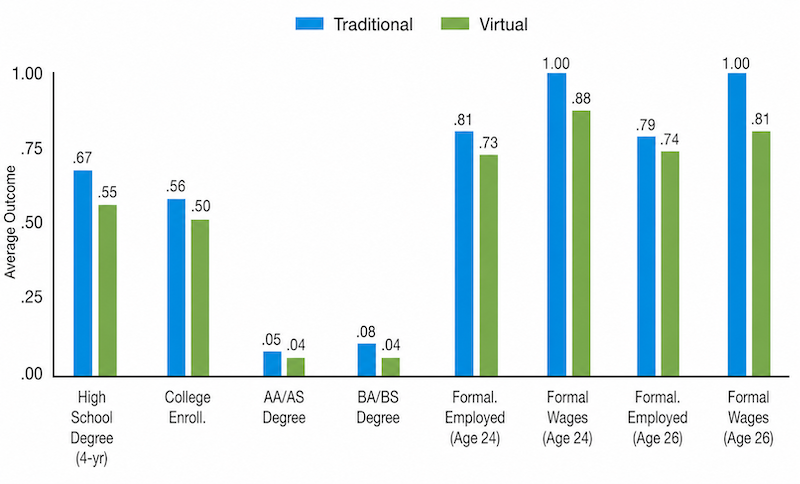
Note: For all outcomes except wages, each bar represents the average probability of the indicated outcome. For wages, the bars represent relative earnings, or approximately how many dollars virtual charter students earned for every dollar earned by comparable traditional public school students. Each green bar represents the observed average outcome of virtual charter students. Each blue bar represents the predicted average outcome of traditional public school students who are similar on 8th grade school indicators, 8th grade test scores, family income, absences from school, race, gender, and other student characteristics. See additional details in the technical report.
Complementing the above analysis, another REACH study led by Julie Marsh and James Bridgeforth examined virtual schooling in Oregon during the COVID-19 pandemic and uncovered persistent concerns about the delivery of instruction and services provided to marginalized students, particularly students with disabilities (SWDs). While the pandemic allowed more families to experience the safety of virtual learning spaces, few schools in the study instituted explicit strategies or structural changes to address the needs of students from marginalized backgrounds. Notably, several leaders confessed that they lacked the capacity to manage the administrative requirements of assessing and monitoring SWDs or providing one-on-one support for “super high needs students.” One leader expressed how challenging it was to provide adequate services during this time of immense growth: “We have 30% [special education] kids in some classrooms, 30%!” According to some reports, virtual school teachers lacked the training to teach SWDs, especially synchronously, and schools did not have personnel to effectively carry out individualized educational plans, particularly ones requiring physical accommodations.
The prior section on governing agencies also described a study by Katrina Bulkley and other REACH colleagues that showed how charter authorizers have different objectives and handle charter applications differently. This highlights that authorization itself can be viewed as a restriction on provider eligibility–schools are only eligible if an authorizer says they are. Authorizers can select and deny schools largely as they wish, so long as they do not trample on civil rights or violate education laws. That flexibility might be desirable, so that authorizers can account for local needs and circumstances, but some may perceive this subjectivity as unfair and it remains unclear how effectively authorizers select schools. Burdensome application processes might also deter applicants with less outside support and prior experience operating charter schools, dissuading community members and organizations from applying.
Summary of Findings
Whether restricting provider eligibility makes sense depends in part on how different types of schools serve students. Our evidence, on virtual schools, combined with other studies, is almost universally negative. Other, non-REACH research similarly suggests that for-profit schools are less effective than others on average.
Policy Implications
In situations where many groups wish to open choice schools and selecting the best candidates is difficult, considering factors such as virtual/in-person and non-profit/for-profit status might increase the odds of success. Another option is to be relatively flexible about which schools can open and to address their successes once results have been observed, through regulatory government accountability systems and parent choices. More on these in the next two sections.
Choice Policy 6: Input/process-based Regulation
One way to improve the quality of choice schools is to find ways to keep out poorly performing schools. Another is to allow schools in but restrict what they do–how they use resources, and what processes they follow. For example, the government could allow private schools to participate but require them to hire certified teachers, choose from a specific set of textbooks, and hold periodic public meetings to advise the local community on their plans and to take input on important school policy decisions. The motivation behind these regulations is the same as provider restrictions–to increase school efficiency and equity.
There is essentially no causal evidence on the effects of regulations on charter schools. In the REACH study, Harris and McKenzie found that, after controlling for various policy differences, there was no clear relationship between the relaxation of regulations and either charter market share or average charter school quality, and there is some suggestion of a negative correlation. Because there is so little evidence, this section is quite short and we turn to the summary, which includes some, though still limited, non-REACH evidence.
Summary of Findings
Beyond the limited REACH evidence, there is evidence that administrators of choice schools have negative views of input regulations. Intense regulations are associated with lower perceived autonomy and less ability to differentiate in the market. They create more administrative and financial burdens and increase negative perceptions of regulators. Further, regulations, such as open-enrollment provisions, testing requirements, and prohibitions on additional tuition payments, reduce private school leaders’ willingness to participate in voucher programs.
One common regulation concerns teacher certification, for which there is a large body of research. Teacher certification is positively, though somewhat weakly, associated with student outcomes in traditional public schools, while also limiting who can teach and in what states. To our knowledge, such evidence does not exist in choice sectors. More generally, little evidence exists on the regulatory effects in any schooling sector and this makes it difficult to judge the effectiveness of including or relaxing such regulation, as is common in most choice regimes.
Policy Implications
The example of teacher certification highlights the likely trade-offs involved in this policy area. Regulations might prevent bad decisions but a potential side effect is imposing unnecessary costs on schools and preventing innovation. This loss of autonomy likely drives out some potential schools. That could be a good thing, especially if it dissuades bad actors.
Choice Policy 7: Outcomes-based Accountability
For the past quarter-century, there has been a general shift from regulating publicly funded schools on their resources and processes and toward holding them accountable for student outcomes, especially test scores, but also high school graduation and attendance–that is, to be “loose on” process, but tight on results. Under school choice, that accountability can also be used to shut down low-performing choice schools.
This form of government-driven accountability can also be contrasted with market accountability. Choice supporters–especially voucher supporters–often argue that government accountability is unnecessary because parents will “vote with their feet” and shut down poorly performing schools on their own. But this logic presumes that schooling markets are competitive, efficient, and equitable, and that the government should pursue no objectives beyond parent preferences.
A vast scholarly literature questions that logic. Parents are poorly informed; distance limits practical schooling options; and schools have incentives to exclude certain students. Also, not all families are in a position to meaningfully “vote” in this way. Those without personal transportation or affordable childcare may be essentially forced to “choose” certain schools to make their lives manageable rather than focusing on academic or other substantive considerations. All of this may stunt the competitive process and stifle outcomes, especially for marginalized groups. This implies that markets might not improve efficiency or equity as described above, unless the government intervenes.
Similar to resource regulations, outcomes-based accountability is perceived to limit schools’ and teachers’ autonomy, leading to homogeneity among schooling options and failure of schooling models that do not focus on test scores. Performance accountability is perceived not only as limiting school autonomy but also as limiting families’ choices.
When a school of choice closes due to low enrollment or underperformance, families view it as unfair, as if their choice and community were taken from them. Performance accountability also creates unintended incentives for schools to actively avoid enrolling low-performing students to maintain the achievement levels needed to avoid closure and sanctions, as well as attract future students. Selective enrollment practices include under-enrollment practices, such as ending mid-year enrollments; burdensome enrollment processes and barriers to access (further discussed above); and active discouragement of students.
In the very first report released by REACH, Douglas Harris and Valentina Martinez Pabon described the general closure and takeover rates across school types. They found that traditional public schools closed at a rate of
1.1% annually. For charter and private schools, the rates were higher (5.4% and 2.9%), respectively–likely because these schools often lack larger organizations like school districts that can absorb declining enrollments and resulting revenue losses. Also, public school attendance zones provide semi-guaranteed enrollment levels.
Figure 12: Annual School Closure Rates Are Highest for Charter Schools and Lowest for Traditional Public Schools—and Declining Over Time
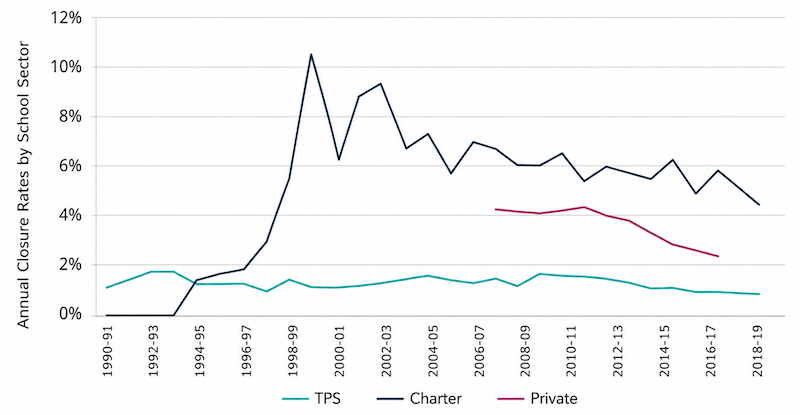
Note: Closure rates include elementary, middle, and high schools and exclude schools with special student populations. Private schools only include those with at least 20 students enrolled.
This study also examined the frequency of school restructuring, in which schools remain open but with changes in governance, leadership, and/or teachers. School takeovers are one example. As with school closures, the rate of restructuring is higher in charter schools, at about 1.6%, compared with 0.5% in traditional public schools. Since restructuring is designed to address performance issues, this suggests that charter authorizers may more aggressively monitor and hold charter schools accountable than traditional public schools. However, it may also be that charter schools are lower-performing. While charter schools are actually higher-performing on average, some research suggests they have a wider range of performance, including more very-low-performing schools, which might trigger restructuring at higher rates.
To better understand the factors driving school closure and takeover across sectors, the same research team estimated the relationship between closure/takeover and factors thought to drive these interventions. The number of students enrolled is a key factor, especially for charter and private schools whose revenue and financial viability are largely dependent on their enrollment numbers. But, here, we are mainly focused on outcomes-based accountability, and the study included three such measures: GreatSchools average star ratings, test score levels, which are the most prominent publicly available information, and achievement growth, which best reflects how much schools actually contribute to students’ academic achievement.
The results, shown in Figure 13, show that both enrollment and the various outcomes are clear predictors of closure/takeover. This pattern is especially strong for charter schools, which suggests that the higher rate of charter closure in Figure 12 is at least partially driven by more aggressive accountability measures by charter authorizers. This approach increases the rate of closure but also prevents low performers from lingering and raises average quality.
Figure 13: High Achievement Is Associated with Lower Chances of School Closure and Takeover–especially for Charter Schools
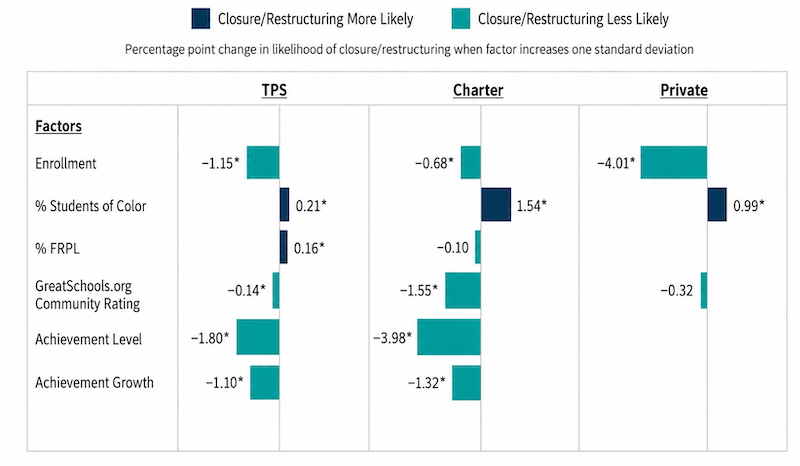
Note: Traditional public schools and charter schools analysis includes elementary and middle schools only. Analysis of private schools includes all schools with enrollment above 20. These results come from the regression results in Appendix Table F6 (Columns 3-5) in the associated technical report and focus on data from 2013-14 to 2017-18. The estimates for each factor reflect the predicted change in closures/restructurings given a one school-level standard deviation increase in the factor (nationally standardized). Each estimate above reflects how much a given factor predicts closure/restructuring, after controlling for the other listed measures (as well as whether the school is located in an urban area). The % of students eligible for free or reduced-price lunch (FRPL), achievement levels, and achievement growth, are not available for private schools. An asterisk indicates that differences in school sector predictors are statistically significant.
Summary of Findings
From the REACH research, we find that charter schools are more likely to close and be taken over than traditional public schools, and that these charter interventions are more strongly driven by academic performance considerations than those in traditional public schools. This suggests that, of all the sectors (traditional public and so on), charter schools are under the most pressure to raise measurable academic achievement.
In our systematic review, we describe evidence from Milwaukee that government accountability in private school voucher programs improves academic outcomes. Also, several studies have shown that when governing agencies close the lowest-performing schools, students directly affected by these closures benefit academically (at least in grades K-8) because they end up in better schools. Future generations of students benefit even more by having a better set of schools to choose from.
Overall, research consistently finds two effects of accountability from governing agencies. First, as intended, accountability improves measurable student academic performance in choice schools. On the other hand, accountability limits schools’ and teachers’ autonomy over school operations, leading to homogeneity in schooling options and the failure of schooling models that do not focus on accountability measures, especially test scores. As in general schooling contexts, accountability likely narrows what schools teach to what is measured. Whether this trade-off is worthwhile depends on the objectives of school choice.
Policy Implications
If policymakers see measurable academic performance as a primary objective, then the research suggests this is more likely when there are active governing agencies (e.g., charter authorizers) tasked with holding schools accountable for those outcomes. However, accountability will also tend to shift schools’ focus away from harder-to-measure aspects that are unlikely to be a part of such systems. One way to navigate this tension is to have softer government accountability and rely on market forces to hold schools accountable, given that parents weigh a range of considerations when choosing schools. Another approach is to give governing agencies discretion to decide how well schools meet student needs overall, including considering hard-to-measure factors and their own judgment, rather than mechanically closing “low-achievement schools.” They can also use differentiated accountability for schools serving special populations, where the usual metrics are less informative or aligned with their missions.
Choice Policy 8: Funding
Money matters. Schools with more funding can hire more educators, pay them higher salaries and provide greater benefits, and purchase newer, better textbooks, equipment, and buildings, which, on average, improve student outcomes. This is likely no less true of choice schools than traditional public ones. (Some argue that alternatives to public schools might even use those funds more efficiently, but this is beyond the scope of our analysis.) Choice schools also receive less funding on average, both from public sources and in total, than traditional public schools. There is debate about the degree to which this is warranted, given that traditional public schools are required to serve all students and disproportionately serve those whose needs incur higher costs, and that they provide a wider range of services and programs than most choice schools. This is most obvious with private schools that can legally select on almost any basis.
The situation is more complicated with charter schools. Charter schools, like traditional public schools, are required to serve all students. However, as noted in the earlier discussion of student enrollment and eligibility, there is evidence that some select students and avoid special education students. One REACH study by Scott Imberman and Andrew Johnson also finds that Michigan charter schools provide less intensive special education services. However, the same study finds that charter schools improved student achievement more for special education students than traditional public schools. This suggests that the types of students served may not be the best guide for determining how much funding schools should receive.
Per-pupil funding in choice can also influence school and household behavior. First, funding influences charter school expansion decisions. Charter operators decide where to expand their networks based on states’ charter school funding formulas and the availability of facilities. Also, households respond to the size of subsidies in private school choice programs. Demand for private school vouchers is higher when vouchers are larger and reduce the amount families have to pay in private school tuition. Current voucher amounts are often insufficient to cover tuition, deterring some families from participating in private school choice programs.
While there is little research on the causal effects of funding in choice schools, one REACH study examined the factors correlated with statewide charter school effectiveness and found that, even after controlling for other elements of school policy, states with higher charter funding relative to traditional public schools, as described by the pro-choice advocacy group Center for Education Reform (CER), had higher levels of student growth on standardized tests. This result was statistically significant for the CER measure, though not for the funding measure created by two other organizations.
Current funding was also seen as insufficient for charter schools to offer services that would increase student racial and economic diversity and accessibility, according to a second study where our team interviewed education leaders about funding. The authors concluded: “In several states, interviewees noted that the inadequacy of state funding for publicly funded schools thwarted efforts to expand or promote greater equity in choice policy.” Interviewees reported that current funding levels are insufficient for charter schools to offer services that will increase student racial and economic diversity and accessibility, such as transportation, and services to adequately serve students who need specialized services, such as students with disabilities and English language learners.
Respondents in Colorado and Michigan argued that charter operators lacked the capacity to serve those students or serve them well. A state board member in Colorado noted,
Most charters don’t recruit [severely disabled] kids. The reason is strictly financial. Special education is extraordinarily expensive. If public schools would be willing to allocate resources to charters…and keep in mind there are economies of scale the districts don’t share with charters, it puts charters in an impossible situation (p. 34).
Similarly, a Colorado choice advocate argued that charter school leaders want to serve students with disabilities, but shied away from doing so because of the cost:
I think a lot of charter leaders are caught in a chicken or egg sort of situation, where they’re desperate to serve more special needs students, but don’t have the resources to do it. I find it frustrating that often people at the capital will use this to point to why we shouldn’t put charters on equal footing, just because they don’t serve an equal number of special needs students. But I think what they’re missing there is that context and the relationship with the actual charter leaders, who want nothing more than to serve more special needs kids, but don’t have the resources to do it (p. 35).
Similar issues were raised in the context of English learners, such as a representative of an equity-oriented non-profit in Louisiana who argued that:
If you have seven [students who are English learners] in your charter, are you going to have a full-time ELD [English Language Development] teacher? Probably not. Are you going to have bilingual certified teachers? Especially if your teachers don’t have to be credential[ed] necessarily or not traditionally credential[ed]? There are lots of ways in which you’re just gonna have far, far less capacity to build because you’re not in an economy of scale (p. 35).
Another respondent, in Michigan, commented that the same applies to transportation. Many charter schools do not provide transportation because they have too little funding. This just reinforces the basic fact that, when funding is lower, something has to give, and schools are apt to focus on providing the bare necessities like instruction very well before spending on optional services or serving students with more expensive needs who might be better served in higher-spending traditional public schools.
Summary of Findings
While little research has been done about the true effects of school spending on choice schools and their outcomes, it is fair to say that money matters for them, too, and that they receive less of it. With lower funding, they cut back on less essential services. In effect, not providing transportation shifts the cost of transportation to parents.
Policy Implications
Discussions of school funding often involve trade-offs. On the one hand, it seems sensible to put all schools on an “equal playing field” and provide the same funding to all. On the other hand, the various schools are on unequal playing fields for reasons other than funding. For example, choice schools are not expected to serve all types of students, including those with more costly needs. Traditional public schools also provide a wider variety of services than other types of schools, in ways that might be beneficial to communities (e.g., offering a broader range of sports and extracurricular activities and more extensive counseling and health services).
Choice policies do tend to equalize per-pupil resources across schools because choice requires that the money follow the students. Many choice systems also use weighted student funding, which provides additional funds to schools serving low-income students and those with disabilities and other special needs.
If policymakers did equalize funding across different types of schools, some additional potential effects are worth noting. Since tax revenues are largely fixed in the short run, this would very likely reduce the per-pupil funding for traditional public schools. Higher funding for choice schools would also shift more students out of traditional public schools, so they would lose twice–fewer students and less funding for each of them. Traditional public schools also have higher “legacy costs” in the form of payments to support the pensions of teachers who worked in the past. While those costs are in some sense the responsibility of traditional public schools, these costs were incurred by policymakers of decades past and ignoring this could also put today’s public schools at a significant disadvantage for reasons outside their control.
The one thing that is certain is that decisions about funding will shape the schools students attend and the type and quality of services they receive.
Choice Policy 9: Coordination and Capacity-building
The level of resources is one thing, but the ability to utilize them is another. Schools can sometimes use their resources more efficiently if there is some coordination and capacity-building across schools.
Such opportunities among choice schools, however, are limited without a mandate from a governing agency. One common area where traditional public schools and choice schools coordinate is the allocation of facilities. In many states, traditional public school districts own school buildings and control access to them, allowing districts to use facilities as a political tool to shape the charter sector. For example, Denver Public Schools made facilities available to charter schools and other semi-autonomous schools if they adopted enrollment practices such as accepting mid-year transfers. Districts can also use their ownership of school buildings to inhibit the growth of their competitors, even when they are compelled to provide facilities to choice schools by law. Instead of providing stable access to standalone facilities, they can offer single-year leases, spread schools out over multiple locations, and co-locate choice schools with traditional public schools, creating uncertainty and chaos. Given these challenges, it is understandable that access to facilities shapes choice school providers’ decisions to expand their networks.
There is very little research on this topic. A partial exception is a REACH study led by Huriya Jabbar and Julie Marsh that focuses on how the nation’s schools responded to COVID. They found little coordination between traditional public schools and charter schools in Detroit. In contrast, New Orleans’ nearly-all-charter system was highly coordinated. This was due to several factors, especially that New Orleans’ system had a single authorizer (the school district) and school leaders had a history of cooperation and coordination, dating back more than 15 years when the state took over the schools and began turning them over to charter school operators. That history was important because, even with a single authorizer, schools had considerable autonomy and could have mostly gone their own way on many key decisions. They chose to cede some of that control back to the district. Schools “found ways to share resources and guidance on online learning and food delivery,” with more centralized moves around “health safety, communication, and transportation” (p. 5). At the same time, once New Orleans was governed only by the locally elected board, school leaders lost some trust in system leaders.
While COVID was an unusual situation, how schools respond in a crisis is telling about whether and how they respond in more common situations. If schools can’t come together during a tragedy like COVID, they are unlikely to do so in other situations.
Summary of Findings
There is little research on this topic, either by the REACH team or other scholars. One exception is New Orleans where researchers have examined informal cooperation across schools and what happened to coordination and capacity-building once all the city’s schools–essentially all charter schools–were “reunified” under the governance of the locally elected board. The New Orleans case highlights an important tension. On the one hand, having a single governing body makes coordination easier because that organization can act alone and this case shows it is possible to force coordination on some matters while maintaining school autonomy over the core functions of management. On the other hand, in this case, the schools did not trust the central office to handle this coordination. However, it is difficult to generalize from this one case.
Policy Implications
The issues and trade-offs here are similar to those above, with active governing agencies and regulation. On the one hand, choice schools prefer to have autonomy. On the other hand, there are certain times when coordination is in their best interest, if they can set aside their competitive instincts. It may be difficult for schools to coordinate on their own, or for the government agency to be involved without becoming overly involved in other areas.
Conclusions about the 9 Key Policy Elements
1. Transportation
Students must get to and from school every day, which significantly limits families’ choices. Our research at REACH, and more studies reflected in our systematic review, show that families are more apt to choose schools
located near their homes even after controlling for school quality and other characteristics. Providing access to transportation reduces this constraint and gives families more options. This is especially true for marginalized families who are less likely to have their own cars and more likely to have jobs with rigid schedules that make school pickup/dropoff more difficult. We have less evidence about effects on student outcomes, but what we do know suggests some, albeit small, academic benefits from transportation access. However, putting resources toward school or mass transit comes at a high cost that could reduce spending on instruction.
2. Enrollment Systems and Student Eligibility
Some schools are more popular than others and end up with more applicants than seats. This scarcity of seats, and the general aim of getting students into their most preferred schools, is handled through enrollment systems. Enrollment systems, however, turn out to be a lot of work for families. They create particular stress when parents receive information late and where there is no default school option. These burdens are more pronounced in decentralized enrollment systems in which individual schools are responsible for soliciting applications and selecting students in their own ways. While difficult to measure, schools also sometimes use decentralized enrollment systems to select students in ways that are not allowed or inappropriate. This, combined with academic requirements that further restrict access, means that marginalized groups face the greatest burdens and the most restrictions on schooling access. Centralized enrollment systems are less burdensome than decentralized ones, and increase access for marginalized groups, but their complexity and opaqueness lead some families to see centralized, algorithm-based systems as illegitimate and unfair.
3. Information
Information is important in all types of decisions, including the schools families choose. Some schooling information comes from official sources such as government websites, local school information fairs, school advertisements, and personal guidance from counselors. But the most important source is family social networks. Research shows that providing information beyond these usual sources consistently alters families’
school choices, suggesting that the usual sources leave families imperfectly informed and that additional, coordinated information sources would improve choices and outcomes. As with transportation and enrollment systems, marginalized groups are at a disadvantage when it comes to information.
4. Governing Agencies
Governance means setting policies, plans, and objectives, which includes making decisions about which schools should receive public funds, determining whether schools are complying with rules, setting academic and non-academic goals, and assessing progress toward those goals. These decisions depend on which government agencies are actually doing the governing. Charter schools have “authorizers” for this purpose. With vouchers/ESAs, in contrast, no governmental agency is typically tasked with active governance. Our review suggests that the presence, number, and type of active governing agencies affect the number of choice schools available and likely affect the quality and types of schools as well. School districts authorize fewer charter schools because this entails creating competition for the schools they already govern and manage. So, the more authorizers available to open schools, the more schools will open. Additional governing agencies also likely increase the range of school types that open because, we show, different agencies have different objectives. Other evidence focuses on how private schools are averse to having active governing agencies.
5. Provider Eligibility
Almost all choice programs are subject to at least some minimal type of school eligibility criteria. Even tuition-based private schools usually have to be accredited (Arizona and Florida are exceptions). Charter schools also have to apply and be selected by a charter authorizer to become eligible. Such restrictions make it possible, in theory, to prevent certain types of schools, such as low-quality ones, from opening or receiving public funds. For-profit, virtual, and standalone charter schools have worse academic performance on average compared with non-profit, brick-and-mortar, and CMO/network schools, so excluding or restricting these types of schools could improve outcomes. We have little evidence on the effects of accreditation in part because so few non-accredited schools ever open and have measurable outcomes.
6. Input/process-based Regulation
Another potential way to help ensure that all students experience a high-quality education is to regulate schooling resources and processes, e.g., requiring that teachers be certified or requiring open meetings. Very little research exists on this topic and the idea runs against a basic principle of school choice—that schools should have autonomy to meet student needs in their own way. We do know that administrators of choice schools have negative views of input regulations. Intense regulations are also associated with lower perceived
autonomy and less ability for market differentiation. They create more administrative and financial burdens and increase negative perceptions of regulators. Further, regulations, such as open-enrollment provisions,
testing requirements, and prohibition of additional tuition payments, reduce private school leaders’ willingness to participate in voucher programs. It remains unclear whether such regulations improve school effectiveness and/or keep high-quality schools from participating in choice programs.
7. Outcomes-based Accountability
For the past quarter-century, there has been a general shift from regulating publicly funded schools on their resources and processes and toward holding them accountable for student outcomes, especially test scores,
but also high school graduation and attendance. School choice is also motivated by this goal of being “loose on process, but tight on results.” Research consistently finds two effects of accountability from governing agencies in choice settings. As intended, accountability improves measurable student academic performance in choice schools and improves the quality of options available. On the other hand, accountability limits schools’ and teachers’ autonomy, leading to homogeneity among schooling options and failure of schooling models that do not focus on achievement. Whether this trade-off is worthwhile depends on the objectives of school choice.
8. Funding
Money matters. Schools with more funding can hire more educators, pay them higher salaries and provide greater benefits, and purchase newer and better textbooks, equipment, and buildings. This is likely no less true of choice schools than traditional public ones, though there is almost no direct evidence on the funding of choice schools. Choice schools do receive less funding than traditional public schools, but there is debate about the degree to which this is warranted, given that traditional public schools are required to serve all stu-
dents and disproportionately serve those whose needs have higher costs, and that they provide more expensive and wider-ranging services and programs, on average, compared with choice schools. Funding of school vouchers is further complicated by a trade-off between keeping tuition low and opening access to low-income students versus allowing schools to charge more and therefore have more educational resources with which to serve students—a trade-off between equity and resource levels.
9. Coordination and Capacity-building
The market logic treats schools as individual organizations, but schools and students may benefit when schools coordinate and build capacity together. This is the least studied of the nine policy elements. The clearest examples of coordination involve centralized enrollment systems (discussed above), shared special education services, and the allocation of school facilities.
Cross-cutting Conclusions
Several important, overarching conclusions emerge from both the framework and the discussion of empirical evidence:
First, many aspects of choice policy can improve school access, but they vary dramatically in cost. Our review of the evidence shows that improved transportation, information, and school accountability have made small improvements in access or academic outcomes, especially for marginalized students. However, the first item in this list–transportation–is a much more expensive strategy, which means that adopting it is likely to shift funding from teacher hiring, salaries, and other important resources. On the other hand, improved transportation does more to shape the set of options or the options selected by families. Information and accountability place more control in the hands of government, which some may interpret as more paternalistic than transportation.
Second, there is considerable room to make choice policies better serve marginalized students. Many dimensions of policy, especially enrollment systems, have the potential to significantly improve access to quality schools for marginalized students, but this potential is underutilized. As is often the case in public policy, there are also trade-offs between equity, efficiency, and other objectives. In this case, choice policy acts as a sorting mechanism that improves access for one group while reducing it for others, especially in oversubscribed schools.
Third, some of these same policies have the potential to improve efficiency and equity simultaneously. Information is one example. If the information impacts we observe mean that people make better decisions when they have more information, and if information is unequally distributed, then providing more information improves equity and efficiency at the same time. This implies that the usual trade-offs between equity and efficiency might not apply in schooling. Doing more to help marginalized students might improve efficiency as well, a kind of “double dividend.”
Fourth, policy effects on access to choice schools are somewhat detached from effects on academic outcomes. Policies like transportation improve access and change the schools that students attend, but this does not necessarily increase academic outcomes. This conclusion aligns with prior evidence that families view academic outcomes as just one of many considerations when choosing schools. A related implication is that the focus on access versus academic outcomes reflects a judgment about how we balance family preferences and broader goals that governments pursue on behalf of the public.
Fifth, implementation appears to be at least as important as policy design. We outline a number of ways in which key actors (parents, educators, government officials) exercise discretion in the choice process, which also point to ways in which implementation might be important. A few of these have been studied (e.g., how authorizers set their priorities when soliciting school applications), but many have not. The appendix to the technical report provides a list of areas where key actors in schooling exercise discretion that affects school choice and, therefore, may be important for implementation.
The above conclusions inform a rapidly changing and increasingly choice-based schooling environment. Our analysis also lays out a future research agenda for school choice. Most of the ideas we have proposed pertain to the specific policy elements discussed above. In addition, we identify several cross-cutting questions here. For example, while research on all nine policy elements is lacking, this is especially true on the supply side. Researchers have been actively studying choice from a household perspective, but have focused less on the school perspective. We know little about the effects of school funding (in choice settings), provider eligibility, input-based regulation, outcome-based accountability, capacity-building and coordination, or governing agencies.
Also, in the U.S., essentially all local markets are now mixed markets. At a minimum, almost every household in America has access to a traditional public school, a virtual school, and homeschooling options. Most also have access to tuition-paying private schools, and many can access vouchers and open enrollment among traditional public schools. However, research tends to focus on the separate types of choice schools, neglecting how they interact with each other.
Finally, we note that future analysis of choice policy should recognize how the effects of decisions about each choice policy depend on decisions about the other policy elements–they are interconnected. For example, if government funding levels were very low, tuition and fees might be more justifiable to supplement total resources in ways that improve outcomes, albeit with some sacrifice in equitable access. Also, if schools are allowed to use essentially any admission requirements, then centralized enrollment systems probably matter less. A broader implication is that it is difficult to generalize about what the “optimal design” is for each individual policy element.
The complexities of school choice need to be recognized by policymakers in designing policies, by educators implementing them, and by researchers studying them. Here, we have tried to provide a structure to make sense of this complexity as choice continues to expand.